
Why Enquiries Do Not Become Customers: A Practical Review
Review enquiry relevance, offer clarity, response arrangements and follow-up before assuming that more traffic or advertising is the answer.

An enquiry is an expression of interest, not a confirmed customer. When enquiries do not progress, examine the journey from the original offer through response, clarification and follow-up. More traffic may increase volume without resolving the reason existing enquiries are being lost.
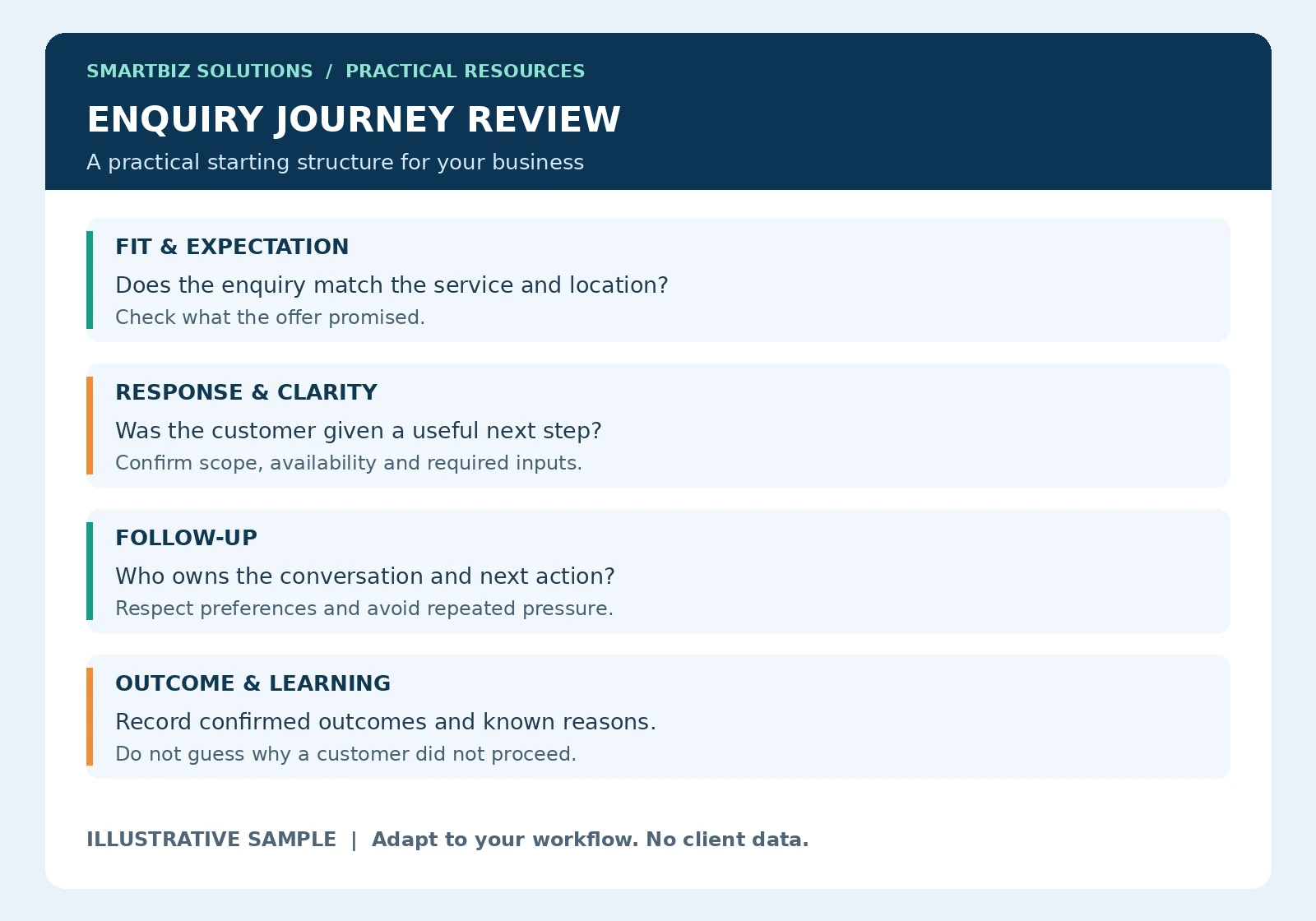
Practical starting point: Adapt the sample to your workflow. Examples are illustrative and do not represent client results.
Check whether enquiries fit the offer
Start by defining a relevant enquiry. Consider the service requested, service area, eligibility or availability and the customer’s stated need. A request outside your operating area is different from a suitable request that received no response.
Record these differences using a small set of clear categories. Do not label every unconverted enquiry as poor quality. Sometimes the message attracted the right person but the next stage did not work.
Compare the promise with the real service
Read the advertisement, social post or website page that the customer saw. Does it imply a price, outcome, availability or turnaround that your business cannot confirm? Does it omit information the customer needs before enquiring?
Make the offer specific enough to set useful expectations. Explain the service scope, what information is needed and how a quote or next step is determined. This can help customers decide whether to continue without relying on an unrealistic promise.
Review the first response
Check whether the enquiry reached the right person and whether that person had enough context to reply. A generic “please call us” response may add effort when the customer already explained the need. A useful reply acknowledges the request, clarifies missing facts and explains the next step.
Agree response arrangements that your team can maintain, including cover during absence and the handling of after-hours messages. There is no universal response deadline suitable for every service. Set a realistic internal commitment and monitor exceptions.
Remove friction from the next step
A customer may need to share a brief, attend a discussion or review a quotation. Make that action understandable. Avoid asking for information that is not yet needed, sending inconsistent versions of the offer or requiring the customer to repeat the same details to several people.
If your proposal has options, explain their practical differences. Identify what is included, what depends on customer inputs and which costs are separate. Clear boundaries support an informed decision even when the customer chooses not to proceed.
Illustrative example: website-development enquiries
Imagine a business receiving requests for a low-cost website after promoting a broad “complete website” offer. Some customers expect hosting, domain, content, unlimited revisions and an online store. If the actual package covers a smaller service website, the disagreement began before the first conversation.
The useful correction is to clarify the advertised scope and provide a simple requirement checklist. The team should also confirm who prepares the quote and records the next action. This example does not establish why any real SmartBiz enquiry was lost.
Follow up with purpose
Agree what the customer needs to decide and whether a follow-up is appropriate. Record the next-action date and owner. A follow-up should add useful clarification or check whether assistance is needed, while respecting the person’s preferences.
Repeated pressure is not a substitute for relevance. If the customer declines or asks not to be contacted, reflect that in the record. Keep only information needed for the business process and manage access appropriately.
Use a simple outcome tracker
- Enquiry reference and date received.
- Requested service and source, where known.
- Responsible person and latest meaningful action.
- Next action and agreed date.
- Outcome: open, confirmed, declined or another defined status.
- Reason given by the customer, or “not known” when no reason is available.
Interpret conversion figures carefully
Choose a defined group of enquiries and a reasonable observation period. If 20 enquiries arrive this week, some may need longer to decide. Comparing them immediately with customers confirmed this week can mix different groups and misrepresent progress.
Use the sample above as a review checklist rather than a reason to assign blame. Examine a small set of conversations with the team, identify recurring issues and test one improvement at a time. Document the change and review whether the process became clearer.
Frequently asked questions
Does a low conversion rate always mean the ads are wrong?
No. The offer, enquiry fit, destination, response and follow-up can all matter. Investigate the available evidence before choosing a fix.
Should we reduce prices first?
First understand the customer’s stated concern and the service fit. Price is one possible factor, not a confirmed explanation for every lost enquiry.
Can every enquiry be converted?
No. Some requests will not suit the service or the customer’s circumstances. Record outcomes honestly rather than promising a universal conversion target.
Make the journey easier to manage
Explore lead-generation and enquiry-journey support, campaign-objective planning and SOPs for a repeatable response process.
Discuss your requirement on WhatsApp · Use the free SOP template to document your enquiry follow-up · Back to Insights & Resources