
Business Plan vs DPR: Which Document Does Your Business Need?
Understand the purpose of a business plan and a DPR, choose the right scope and prepare the information needed before drafting.

A business plan explains how a business intends to operate and develop. A Detailed Project Report, or DPR, develops a specific project in greater implementation detail. Their content can overlap. Choose the document by its purpose, intended reader and required format rather than by the title alone.
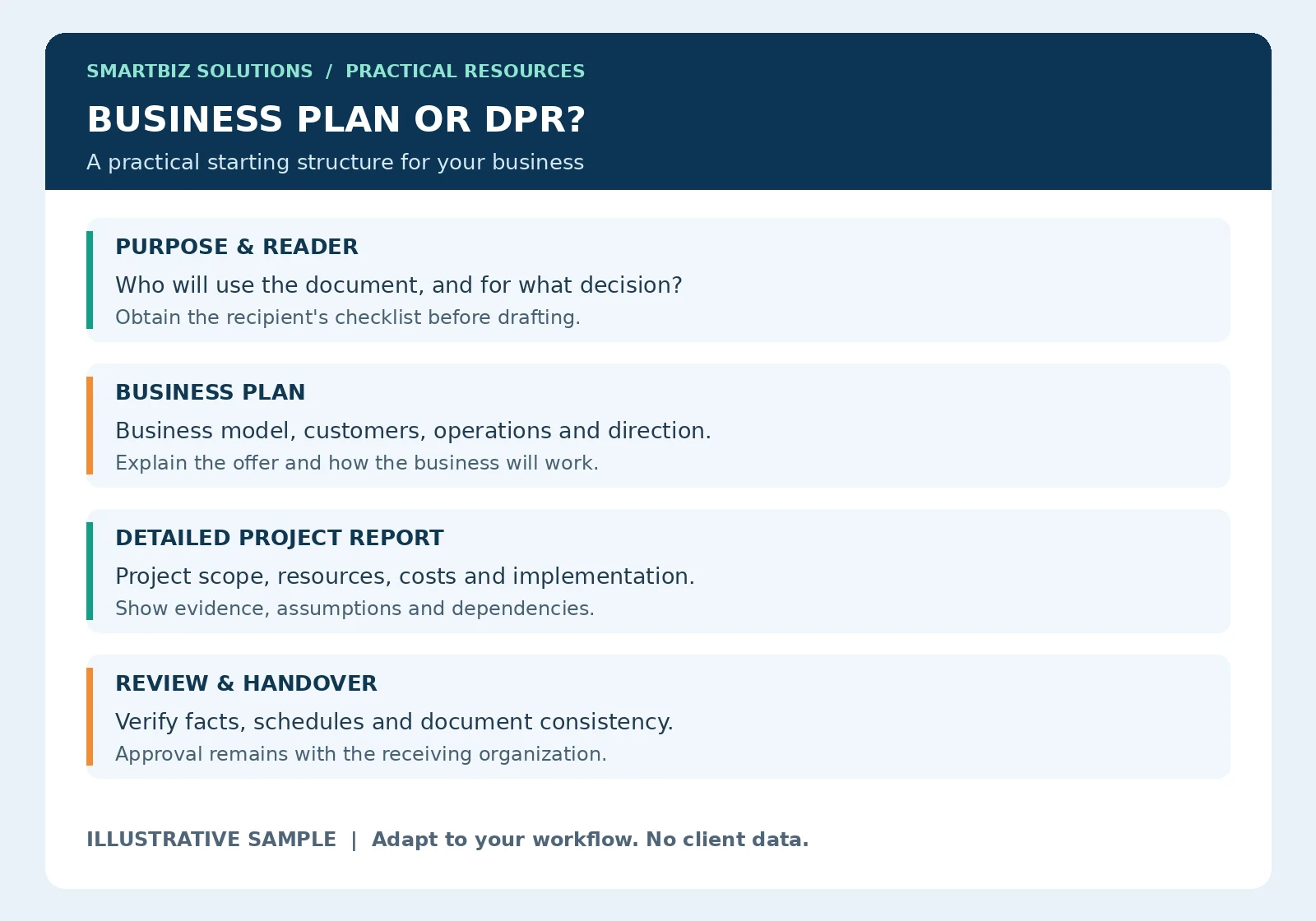
Practical starting point: Adapt the sample to your workflow. Examples are illustrative and do not represent client results.
Start with the decision the document must support
Before requesting a report, write one sentence explaining what it is for. You may need to clarify a new service, discuss an expansion, obtain internal approval or respond to an institution’s document request. Each purpose changes the level of detail and supporting evidence needed.
Ask the recipient for its current checklist or template. A document called a business plan may require detailed project schedules; a document called a DPR may use a prescribed format. The recipient’s requirements are more useful than an assumed universal structure.
What a business plan usually explains
A business plan connects the offer, target customers, operating approach and intended direction. It helps the reader understand what the business will do, why the offer is relevant and how the proposed work fits together. It may be concise for an early discussion or detailed when the reader needs more evidence.
- Business purpose, products or services and the customer problem addressed.
- Target customers, market context and the basis for important assumptions.
- How enquiries, sales and service delivery will be managed.
- Roles, resources, milestones and measures used to review progress.
- Cost and revenue assumptions appropriate to the agreed document scope.
What a DPR adds to a project discussion
A DPR typically develops a defined project’s scope, resource requirements, estimated costs, implementation sequence and dependencies. The detail should help someone review what is proposed and what must happen for it to work. Supporting quotations, layouts, schedules and technical inputs may be needed depending on the project.
A report writer should identify where specialist inputs are required. Engineering assessments, certifications, legal requirements and financial appraisal are not replaced by a well-formatted document. Confirm the required professional reviews before a submission deadline.
Illustrative example: expanding a small hotel
An owner exploring a new guest-service concept may first need a business plan describing customers, the offer, delivery arrangements and operating assumptions. If the discussion moves to a specific expansion involving rooms, equipment and staffing, a DPR may need to develop the implementation requirements and supporting schedules.
These documents can share a fact base, but should not contradict each other. If the capacity changes in one section, review staffing, equipment and related estimates elsewhere. The example illustrates document scope; it does not establish permissions, project viability or approval requirements for a real property.
Prepare an input pack before drafting
- A clear description of the business and proposed project.
- The intended reader, required format and submission date.
- Available quotations, source records and ownership of key facts.
- Capacity, staffing and operating assumptions that the project owner can explain.
- Known dependencies, unresolved questions and specialist inputs still required.
Separate confirmed facts from assumptions. Keep the source date beside quotations and estimates. If information is unavailable, list the gap and the person responsible for resolving it. Filling gaps with invented numbers can make a report look finished while leaving its reasoning unreliable.
How to use the sample document brief
The sample above is a scoping worksheet, not a completed business plan or DPR. Work through purpose and reader first, then select the sections required for that decision. Use the final review row to agree who checks facts, who reviews specialist material and which editable files form the handover.
Review the document as one connected proposal
Check the executive summary against the main text. Reconcile repeated figures and dates, confirm that schedules use the same assumptions and label unresolved dependencies. Ask a reviewer unfamiliar with the project to explain the proposal back to you. Their questions often reveal missing context.
Keep a version record and a single approved source pack. If the recipient requests revisions, record what changed and review the related sections. A polished cover or a longer report is not a substitute for consistent, supported information.
Frequently asked questions
Does every startup need both documents?
No. Begin with the actual decision and recipient requirement. One document may be sufficient, or a business plan may later provide inputs for a more detailed project report.
Does a DPR guarantee funding or approval?
No. The receiving organization decides what it will accept and may request further information, appraisal or professional sign-off.
Can an existing report be improved?
Yes. Start by checking its purpose, current facts, assumptions and recipient requirements. Updating the cover date alone does not make old estimates current.
Discuss the right document scope
SmartBiz Solutions supports business documentation and DPR preparation. Once implementation begins, process documentation and management reporting can help record and monitor the agreed work.
Further reading: SBA business planning resources provide general planning guidance. They are not an Indian institution’s submission checklist.
Discuss your requirement on WhatsApp · Get free editable templates and use the reporting-time calculator · Discuss Your Business Plan or DPR · Back to Insights & Resources