
SEO vs AEO: A Practical Guide for Small Business Owners
Understand how SEO and answer-focused content work together, and use a practical checklist to improve website clarity and search readiness.

SEO helps search engines discover and understand useful website pages. AEO is a term commonly used for making information easier to use in answer-focused discovery. They overlap: clear services, accessible pages and reliable answers support both. AEO should not be treated as a guaranteed shortcut to AI recommendations.
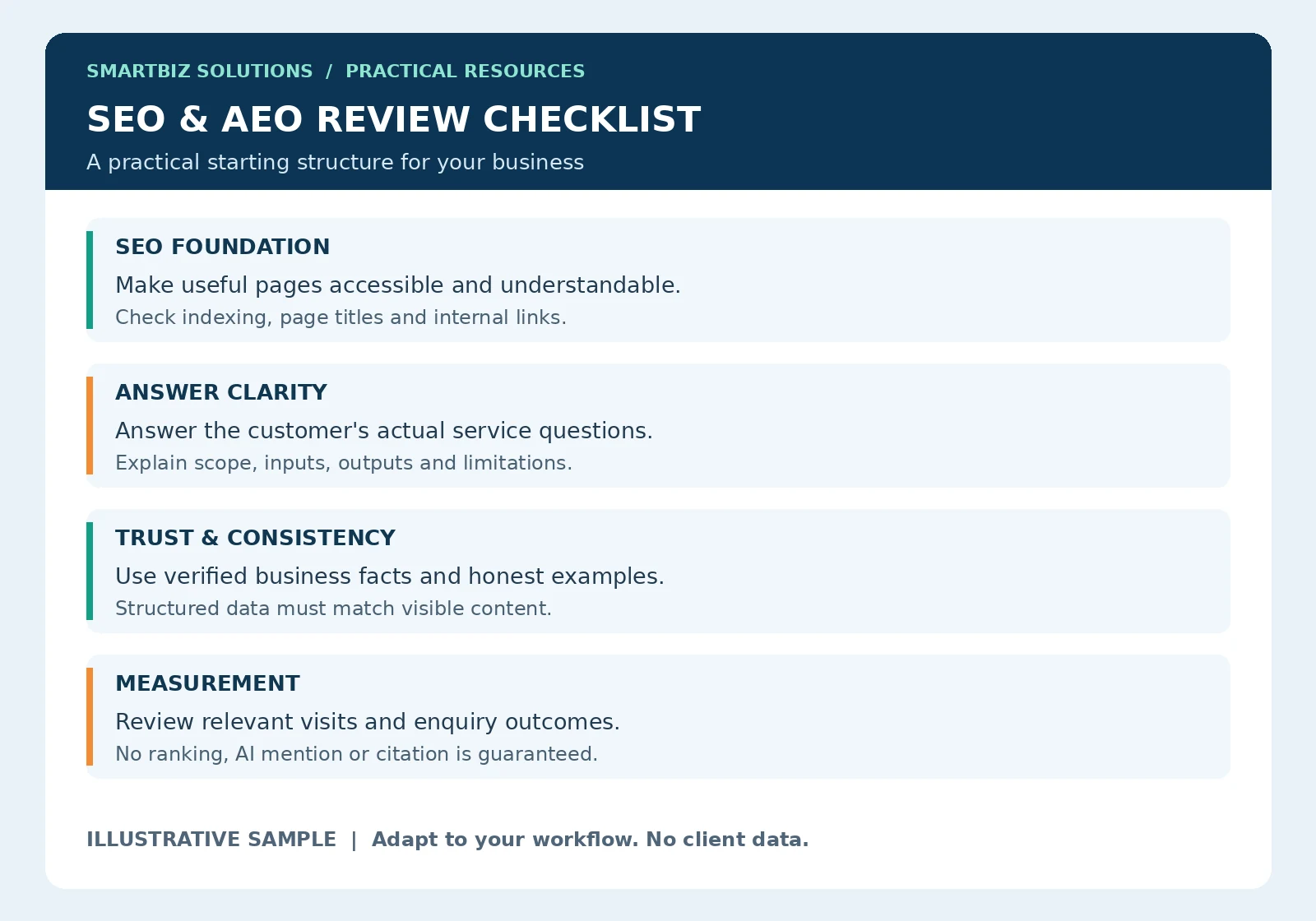
Practical starting point: Adapt the sample to your workflow. Examples are illustrative and do not represent client results.
What SEO covers
Search engine optimization involves the technical accessibility, organization and content of a website. A service page should clearly explain what it offers, who it helps and how a visitor can take the next step. Page titles, headings, navigation and internal links help organize that information.
Technical checks include whether a page can be crawled and indexed, which URL is canonical and whether important content is available to search systems. Publishing a page does not prove it is indexed, and indexing does not guarantee a particular ranking.
What people mean by AEO
Answer Engine Optimization usually describes work that makes direct answers and business information easier to interpret. This can include concise definitions, realistic FAQs, clear steps, source references and consistent entity information. Different providers may use the term differently, so ask what specific work is included.
For a small business, a useful starting question is: can a visitor understand the service without guessing? If the page says only “complete solutions for growth,” adding an FAQ label will not resolve the lack of detail.
How the two approaches overlap
Google’s documentation states that foundational SEO practices remain relevant to its AI features and that there are no additional special optimizations necessary for AI Overviews or AI Mode. This is guidance about Google’s systems; other platforms may use different processes.
The practical implication is to improve the useful page itself. Avoid buying a promise of guaranteed AI mentions or creating pages solely to repeat variations of the same question. Search and answer platforms decide what to retrieve, display and cite.
Illustrative example: make a service explanation concrete
A vague page might say, “We automate your business with AI.” A clearer explanation would identify a defined task: reviewing sample reporting inputs, preparing a draft-summary workflow and agreeing human checks before handover. It would also state that tools, access and subscriptions depend on scope.
The clearer version gives a reader more information for a decision. It does not prove that the service will appear in an AI answer. The example illustrates writing clarity, not a measured search result.
A practical website-readiness checklist
- Write a distinct title and one clear main heading for each core page.
- State the service, intended customer and geographic availability accurately.
- Explain inputs, deliverables, process and important dependencies.
- Answer real customer questions without inventing prices or guarantees.
- Link related service and educational pages where the connection is useful.
- Check canonical URLs, indexability and sitemap inclusion.
- Use structured data that represents the visible page accurately.
Use evidence and examples responsibly
A sample document can demonstrate structure, while a verified client case can describe real work. Label them differently. Obtain permission before sharing confidential project details and support quantified outcomes with a clear measurement basis.
Keep business names, service descriptions and contact details consistent across pages. Update outdated information when the service changes. A well-written article cannot compensate for a contact page that gives an incorrect service or an unreachable enquiry route.
How to use the sample checklist
Review one important service page against each row. Record the issue, the evidence and the person responsible for fixing it. Separate a content gap from a technical problem: unclear deliverables need a writing change, while an unintended noindex instruction needs a technical correction.
Verify the published output after changes. Stored SEO settings and live page output can differ because of theme rendering, plugin behavior or caching. Keep an honest record of what was checked and what remains unknown.
Measure business relevance
Use available Search Console and analytics data to review relevant queries, page visits and enquiry activity. Define enquiry events and check that tracking works before treating the numbers as reliable. AI visibility samples vary by query and time and should be recorded with that context.
Frequently asked questions
Will adding FAQs guarantee a rich result?
No. FAQs can help readers when they answer real questions. Search-feature eligibility and display are separate decisions made by the platform.
Can AEO replace SEO?
They share many foundations. Clear answers still need accessible pages and useful supporting information.
How quickly will results appear?
There is no fixed timeline that applies to every website. Crawling, competition, demand and the quality of the work all affect visibility.
Improve the foundations first
Explore SEO and AEO services and WordPress website development. Further reading: Google Search Central: AI features and your website.
Discuss your requirement on WhatsApp · Request an SEO & AEO Website Review · Back to Insights & Resources