
Which Website Does Your Business Need? A Guide to Six Useful Types
Compare business, hotel, education, portfolio, landing-page and catalogue websites by their customer journey and practical requirements.

The right website is the one that helps your customers complete a useful next step and that your business can keep accurate. Choose the structure around the audience, information and enquiry journey. More pages or more features do not automatically create a better result.
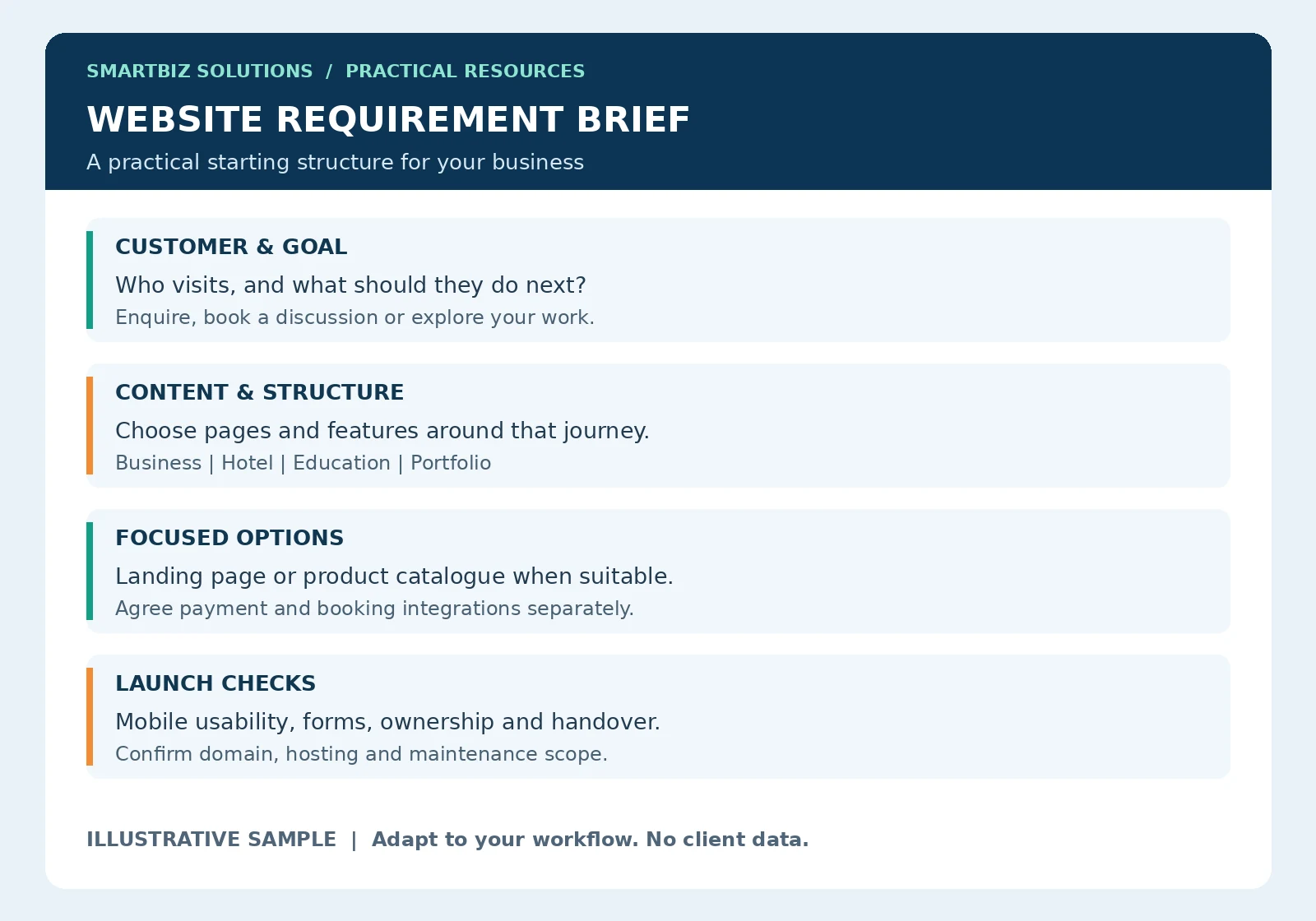
Practical starting point: Adapt the sample to your workflow. Examples are illustrative and do not represent client results.
1. Business and service website
A business website explains who you help, what you provide and how to contact you. A practical starting structure includes Home, About, Services and Contact. Dedicated service pages are useful when different services have distinct questions, inputs and deliverables.
For an illustrative local service provider, a visitor should be able to confirm the service area, understand the scope and send a relevant enquiry. Avoid vague claims that give little help in deciding whether the service fits.
2. Hotel or guest-house website
A hospitality website can present rooms, amenities, location, access information, photographs and an enquiry route. Visitors need accurate descriptions and clear distinctions between an availability enquiry and a confirmed booking. Photographs should reflect what the guest will actually receive.
A live booking engine, online payment, inventory connection or channel-management integration requires a separate technical and commercial assessment. Agree who updates rates and availability before promising automatic booking functionality.
3. School or coaching website
An education website can organize programmes, courses, batches, facilities, location, contact information and current notices. Parents and students should be able to find the relevant information without searching through an unrelated promotional page.
Assign an owner to update dates, fees, eligibility and admission information. Publish only claims and results the organization can verify. Student photographs or personal details need the appropriate permissions and handling process.
4. Portfolio or personal-brand website
A portfolio website introduces a professional, shows selected work and explains the services available. It suits consultants, freelancers and other professionals who need to demonstrate their approach. Each sample should describe the objective, work performed and any limitations on what can be shared.
Label demonstration projects as examples. Do not present an invented client, endorsement or result as real. A concise project explanation can be more useful than a large gallery with no context.
5. Landing page
A landing page focuses on one offer or campaign. Its sections usually explain the audience, problem, offer, relevant evidence and one clear action. It can support enquiries for a course, consultation or defined service without requiring the visitor to navigate the entire site.
The advertisement or social post should match the page’s promise. A landing page does not remove the need for accurate contact details, suitable privacy information or a functioning follow-up process. It may sit within an existing website rather than require another domain.
6. Product catalogue or online store
A catalogue helps customers explore products and request information. An online store adds transactions and operational requirements such as order handling, payment integration and customer support. These are different scopes and should be priced and assessed separately.
For SmartBiz projects, availability of catalogue, checkout, inventory and payment features must be confirmed during scoping. A description of a website type is not a promise that every integration is included in a standard WordPress build.
Use the sample brief to make a choice
Write down the main visitor, the information they need and the action you want them to take. Then list the pages needed to support that action. If the visitor needs broad business information, a service website may fit. If one offer is the focus, a landing page may be sufficient.
List integrations separately from page content. Specify whether the site only receives enquiries or must interact with booking, payment or other systems. This distinction affects access, licences, testing and ongoing responsibilities.
Prepare content and ownership before design
- Approved business name, logo and contact details.
- Verified services, location and operating information.
- Photographs and work samples you are permitted to publish.
- A named person to review content and respond to enquiries.
- Domain, hosting, access, maintenance and handover requirements.
Check the complete customer journey
Read the pages on a phone, open the contact route and confirm that the next step is understandable. Check labels and required form fields, then verify delivery through an agreed test. A form that appears on screen is not evidence that messages arrive correctly.
Frequently asked questions
Can I start small and add pages later?
Yes, if the initial structure and platform support the intended expansion. Agree likely future needs before choosing integrations.
Is a website guaranteed to generate enquiries?
No. Relevant visitors, a clear offer, useful information and reliable response arrangements all affect outcomes.
What is included in a standard build?
The agreed proposal should state pages, content, revisions and integrations, plus which domain, hosting, licences and maintenance costs are separate.
Choose a scope around your customers
Explore WordPress website development and enquiry-journey support. Search readiness can be reviewed through SEO and AEO services.
Discuss your requirement on WhatsApp · Discuss Your Website Requirement · Back to Insights & Resources