
Why Your Advertising Budget Should Follow a Clear Business Objective
Define the customer action, enquiry journey and success measures before committing an advertising budget.

Before setting an advertising budget, decide what action you want customers to take and how you will assess it. A campaign designed to introduce a business needs a different evaluation from one intended to generate enquiries. Clear goals help connect the offer, message, destination and follow-up process.
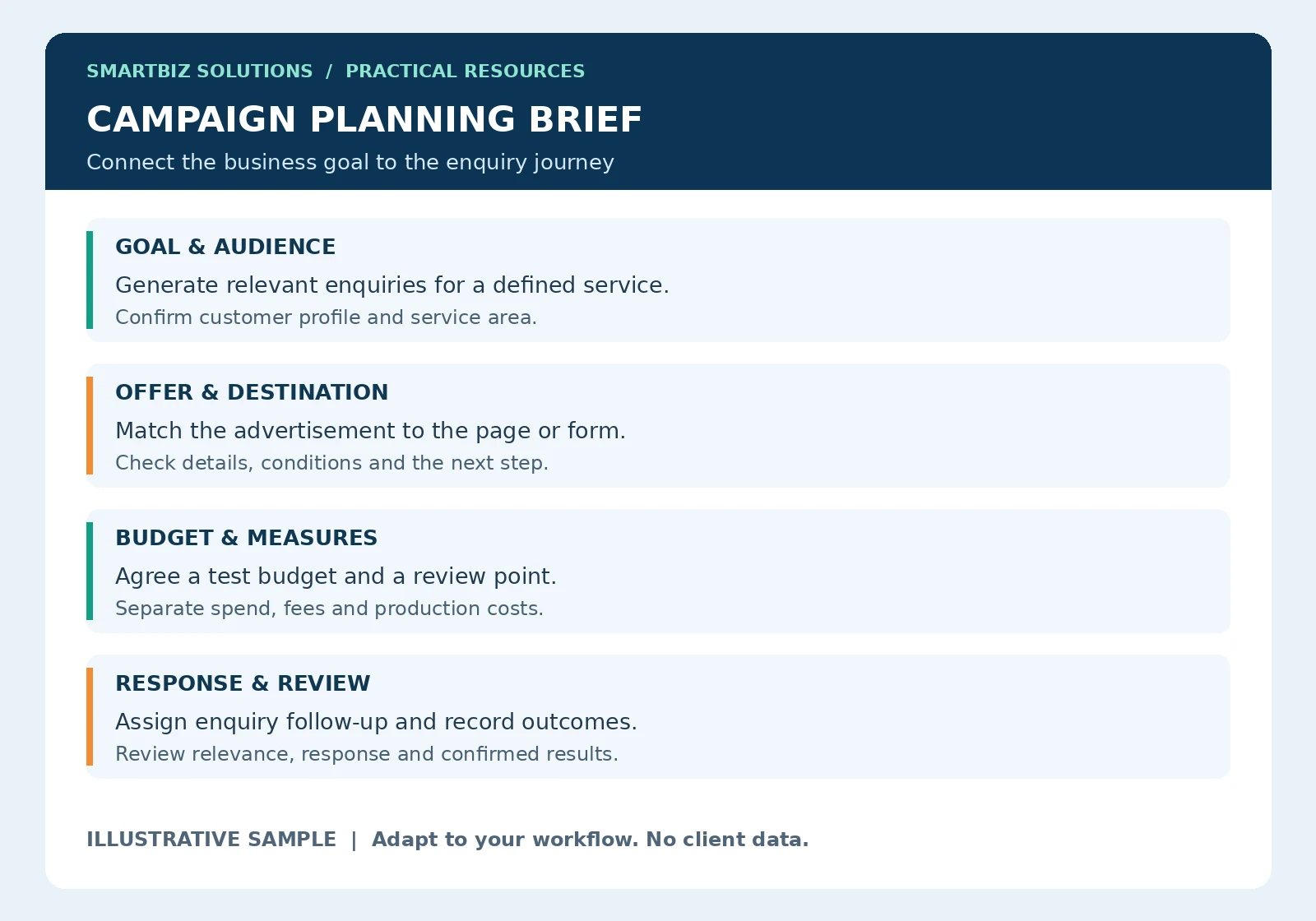
Use the sample as a starting structure. The explanations below show how to adapt it to a real workflow. All numerical examples are illustrative.
Use the sample campaign brief before approving spend
Work through the sample with the person who owns the offer and the person who responds to enquiries. Confirm what is being promoted, where the service is available, the action requested and the destination a customer will reach. Record the approved budget and review point separately.
This exercise often reveals practical gaps before money is spent: a form asks the wrong questions, the page omits eligibility details or nobody is assigned to respond. Resolve those gaps as part of the campaign preparation rather than expecting the advertisement alone to overcome them.
Worked example: distinguish cheap leads from useful enquiries
Suppose an illustrative test spends ₹3,000 and records 30 enquiries. Cost per recorded enquiry is ₹100. If only 12 meet the business’s agreed relevance criteria, cost per relevant enquiry is ₹250. Both numbers can be correct, but they answer different questions.
Neither figure establishes profit or return on investment. You still need confirmed customer outcomes, revenue and the appropriate costs. Record how relevance is judged before comparing tests, and avoid changing the definition after seeing results simply to make a campaign appear better.
Review one stage at a time
If the campaign attracts attention but few people reach the destination, investigate the transition. If people reach the page but do not enquire, review whether the offer is clear and the form works. If enquiries arrive but few progress, examine fit, availability and follow-up. These are investigation prompts, not proof of a particular cause.
Record each meaningful change and the date it was made. Changing the offer, audience, creative and destination together may make it difficult to learn which change mattered. Keep the review grounded in available evidence and preserve a clear distinction between platform attribution and your own customer records.
Describe the outcome in plain language
Replace “we need more promotion” with a specific business intention: introduce a new local service, bring relevant visitors to a course page or generate conversations about room availability. Define who the offer is for, where it is available and what the customer should do next.
Platform campaign settings should then support that intention. Meta’s own training connects campaign objectives to business goals. Available settings can change, so confirm the options in the account when implementing a campaign.
Match the message and destination
- Audience: Identify the people the offer is relevant to.
- Offer: Explain the service, eligibility and important conditions accurately.
- Creative: Give the audience a clear reason to pay attention.
- Call to action: Ask for a specific next step.
- Destination: Ensure the page, form or conversation matches the promise.
- Response process: Assign responsibility for following up.
Example: a coaching institute enquiry campaign
Consider an illustrative institute promoting a defined course. Before launching, it confirms the course details, location, available batches, enquiry questions and who will respond. The advertisement and destination should describe the same course and avoid suggesting admissions or outcomes that are not confirmed.
The institute might monitor relevant enquiries, follow-up completion and admissions recorded from those enquiries. Clicks and reactions can provide context, but they should not be described as admissions. This example is a planning illustration, not a client result.
Choose measures that reflect the goal
For awareness, consider whether the intended audience is being reached. For website visits, examine whether visitors reach the relevant information. For enquiries, define what counts as a relevant enquiry and track the response and outcome where the available data permits.
Agree definitions before comparing campaigns. For example, cost per relevant enquiry means advertising spend divided by the number of enquiries meeting your agreed criteria. State whether the calculation includes advertising spend alone or wider service and production costs.
Plan a test with spending boundaries
Set a test budget your business can afford, a review point and the questions the test should answer. Identify advertising spend separately from creative production, management fees and any third-party tools. There is no universal budget that guarantees customers for every business.
Agree what would cause you to pause, revise or continue. Examples include a broken enquiry form, messages reaching the wrong service area or enquiries that consistently do not fit the offer. Avoid interpreting a small amount of data as a reliable forecast.
Check the enquiry journey before launch
- Open the destination on the devices your customers use.
- Confirm that service information and contact details are current.
- Check that the form collects only information needed for the next step.
- Assign someone to respond and record the enquiry outcome.
- Confirm the approved offer, creative, budget and account permissions.
Review the whole process
Weak results may involve the offer, audience, creative, destination or follow-up process. Review evidence from each stage instead of changing everything at once. Compare like-for-like periods and document meaningful changes so later results can be interpreted.
Advertising reports may attribute outcomes differently from your internal records. Record the source and limitations of each measure. Platform-reported results and confirmed customer outcomes should remain distinguishable.
Frequently asked questions
Do more clicks mean more customers?
No. A click is a step in the journey. Customer outcomes depend on what happens afterwards and must be measured using the relevant records.
Should we increase the budget if enquiries are poor?
First review whether the enquiries fit the service and whether the destination and response process work. Increasing spending does not resolve an unclear offer or a broken contact journey.
Build the journey before spending
SmartBiz Solutions supports social media and Meta Ads management and lead-generation planning. If the offer needs a clearer destination, explore WordPress website development.
Discuss your campaign goal on WhatsApp · Back to Insights
Further reading: Meta Blueprint: Introduction to campaign objectives.